
Last updated:
Table of contents
- What is the average cost of luxury alcohol detox?
- Why does luxury alcohol detox cost more?
- How much does standard medical alcohol detox cost?
- How much more does luxury detox add?
- What does a $10,000 luxury alcohol detox usually include?
- What does a $20,000 to $50,000 program provide?
- Why can some luxury programs cost $80,000 or more?
- Does alcohol detox cost more than detox from other drugs?
- How long does alcohol detox usually last?
- Is a 30-day luxury rehab price the same as the detox price?
- Does health insurance cover luxury alcohol detox?
- How much could you pay after insurance?
- What factors have the biggest effect on luxury alcohol detox cost?
- Length of stay
- Private rooms
- Medical complexity
- Staff-to-patient ratio
- Location
- Psychiatric treatment
- Executive services
- Length of residential treatment
- Are private rooms worth paying more for during alcohol detox?
- How does Florida compare for luxury alcohol detox costs?
- What are you actually buying when you choose luxury detox?
- Is luxury alcohol detox worth the cost?
- What should you ask before paying for luxury alcohol detox?
- Frequently asked questions about luxury alcohol detox costs
- How much does luxury alcohol detox cost?
- How much does standard inpatient alcohol detox cost?
- How much does outpatient alcohol detox cost?
- Can luxury alcohol treatment cost $50,000?
- Can alcohol rehab cost $100,000?
- Does insurance cover alcohol detox?
- Does insurance pay for a luxury rehab room?
- How many days of alcohol detox do you have to pay for?
- Is detox included in the cost of alcohol rehab?
- Is expensive alcohol detox better?
- Sources
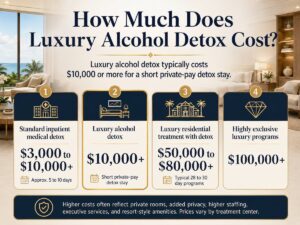
The numbers become much larger when detox is included within a 28- or 30-day luxury residential treatment program. Current private-pay luxury treatment listings can reach $50,000, $80,000, or more for a month. Some highly exclusive programs approach or exceed $100,000.
There is an important limitation when discussing an “average” luxury detox cost. No reliable national database tracks luxury alcohol detox as its own medical category. Treatment providers use the word luxury to describe very different programs, ranging from comfortable private rooms to highly exclusive single-client treatment.
A more useful way to compare costs is to look at the level of medical care, length of stay, accommodations, staffing, and services included in the quoted price.
This guide compares those costs and explains what patients and families are actually paying for when choosing a luxury alcohol detox program.
What is the average cost of luxury alcohol detox?
For planning purposes, a private luxury alcohol detox program generally starts above the cost of standard inpatient detox. Published treatment cost estimates place traditional inpatient detox at approximately $3,000 to $10,000 or more for a five- to ten-day stay. Luxury and premium detox programs can exceed $10,000 for the detox period alone.
The price can increase considerably when detox is part of a longer residential treatment package.
| Type of Alcohol Treatment | Typical Published Cost Range | Typical Length | What It Usually Includes |
|---|---|---|---|
| Outpatient detox | $250–$800 per day | Several days | Clinical visits, monitoring and medication when appropriate |
| Standard inpatient medical detox | $3,000–$10,000+ | About 5–10 days | 24-hour supervision, room, meals and withdrawal management |
| Luxury alcohol detox | $10,000+ | Often several days to about 10 days | Medical detox plus upgraded privacy, rooms, meals and amenities |
| Standard inpatient rehab | Approximately $10,000–$30,000 | About 30 days | Residential treatment, therapy and structured addiction care |
| Luxury residential treatment with detox | $20,000–$80,000+ | Usually 28–30 days or longer | Detox, residential treatment, private accommodations and premium services |
| Ultra-private or executive treatment | $80,000–$100,000+ possible | Several weeks or longer | Highly individualized care, extensive privacy and executive services |
These figures should be treated as planning ranges rather than fixed prices. Treatment centers calculate costs differently, and many luxury programs do not publish their private-pay rates online.
A person may also require fewer or more days of medical stabilization than originally expected. Alcohol withdrawal is driven by medical factors rather than a hotel-style reservation period.
Why does luxury alcohol detox cost more?
The higher price of luxury detox usually comes from several expenses being combined into one program.
Medical withdrawal management is only one part of the bill. Higher-end facilities may also provide private bedrooms, lower patient-to-staff ratios, chef-prepared meals, psychiatric services, private transportation, wellness services, individual therapy, and larger residential properties.
Privacy can be particularly expensive to provide. A treatment center serving a small number of patients still needs nurses, medical providers, therapists, support staff, security, housekeeping, food services, and administrative staff.
A smaller census spreads those costs across fewer patients.
Some executive programs maintain separate residences or private sections of a larger campus. Others accept only a handful of patients at a time. Extremely private programs may dedicate significant staff resources to one client.
That is why two facilities that both describe themselves as luxury detox centers can charge very different prices.
How much does standard medical alcohol detox cost?
Standard medical detox provides a useful baseline for understanding the luxury premium.
Current treatment cost estimates commonly place outpatient detox at approximately $250 to $800 per day. A complete outpatient detox may therefore cost roughly $1,000 to $5,600 depending on its length and intensity.
Inpatient detox costs more because the patient stays at the facility and receives continuous supervision. Published estimates place inpatient detox at approximately $3,000 to $10,000 or more for a five- to ten-day stay.
Alcohol detox can require closer monitoring than some other forms of withdrawal because severe alcohol withdrawal can produce dangerous complications.
The National Institute on Alcohol Abuse and Alcoholism explains that a small proportion of people with alcohol use disorder require several days of detox to manage potentially dangerous withdrawal symptoms before longer-term treatment begins.
Medical need should therefore determine the level of detox care. Price comparisons become useful after the appropriate medical setting has been established.
How much more does luxury detox add?
There is no standard luxury surcharge.
A center offering a private room, upgraded meals, and a smaller residential environment may cost moderately more than conventional inpatient detox.
A highly private executive program can cost several times more.
Published treatment pricing provides some perspective. Recovery.com currently notes that residential addiction programs in the United States can range from under $10,000 to more than $80,000 for premium single-client care.
Its current luxury Florida listings include some programs with estimated private-pay rates around $79,500 to $95,000 for 30 days. Other Florida listings reach approximately $48,000 to $96,000 per month.
Those prices generally represent longer residential treatment rather than a standalone week of alcohol detox. They still illustrate how dramatically pricing can change once luxury accommodations and individualized residential care enter the picture.
Families should therefore confirm whether a quoted luxury rate covers detox alone or an entire residential treatment program.
What does a $10,000 luxury alcohol detox usually include?
A lower-priced luxury detox may provide the core medical program with several comfort upgrades.
The package may include admission assessment, withdrawal monitoring, medication management when appropriate, nursing care, accommodation, meals, and basic therapy or recovery programming.
Private bedrooms may be included, although some centers charge separately for them.
Additional amenities can include higher-quality meals, fitness facilities, yoga, massage, recreation, landscaped grounds, and more comfortable shared spaces.
A program at this price point may still operate within a larger treatment facility. Patients seeking complete privacy should ask how many people are admitted at one time and whether bedrooms, bathrooms, dining areas, and treatment spaces are shared.
What does a $20,000 to $50,000 program provide?
This price range increasingly overlaps with luxury residential addiction treatment rather than detox alone.
A patient may begin with several days of medical alcohol detox and then remain at the same facility for therapy and residential treatment.
Programs in this range may offer private suites, more individual therapy, psychiatric care, chef-prepared meals, fitness services, massage, transportation, case management, and structured aftercare planning.
Smaller patient populations are also more common.
For many families, comparing a $20,000 or $30,000 detox-only quote with a 30-day treatment package can be misleading. The second program may include several additional weeks of clinical care.
Ask for both the length of stay and the services included before comparing total prices.
Why can some luxury programs cost $80,000 or more?
The upper end of the luxury addiction treatment market operates very differently from conventional detox.
These programs may treat very few people at one time and provide extensive one-to-one clinical services. Some are designed specifically for executives, celebrities, athletes, physicians, business owners, and other clients requiring greater discretion.
The fee may include a private residence, dedicated staff, extensive individual therapy, psychiatric treatment, private transportation, personal training, executive support, and concierge services.
Location can also increase costs. Waterfront properties, large secluded estates, and residences in expensive areas require substantial operating budgets.
At this level, the patient is paying for privacy and individualization in addition to addiction treatment.
The price still does not prove that the clinical program is stronger. Medical credentials, staffing, licensing, withdrawal protocols, psychiatric services, and continuing treatment should be evaluated independently.
Does alcohol detox cost more than detox from other drugs?
The answer depends on the individual rather than the substance name alone.
Alcohol withdrawal can require medication, frequent monitoring, and inpatient medical care when the risk of severe withdrawal is elevated.
Previous withdrawal seizures, heavy long-term alcohol use, older age, medical conditions, concurrent sedative use, and a history of severe withdrawal can influence how closely someone needs to be monitored.
A relatively straightforward detox may cost less because the person requires fewer days and fewer medical interventions.
A more complicated admission can involve additional medical evaluation, medication, laboratory testing, psychiatric services, or transfer to a higher level of care.
For this reason, a treatment center may be unable to provide an exact final price until the admissions team understands the person’s recent alcohol use and medical history.
How long does alcohol detox usually last?
Alcohol withdrawal does not follow the same schedule for everyone.
NIAAA notes that some patients with alcohol use disorder require several days of detox to safely manage withdrawal before beginning a longer-term care plan.
Many commercial inpatient detox programs describe stays lasting approximately five to ten days. The actual duration should be based on symptoms and medical assessment.
Length of stay has a major effect on private-pay cost.
A program charging by the day becomes considerably more expensive when stabilization takes seven days instead of four. Facilities using flat-rate packages may include a set number of detox days and charge more if a patient remains longer.
Ask how additional days are billed before admission.
Is a 30-day luxury rehab price the same as the detox price?
No. This is one of the most common sources of confusion when comparing addiction treatment costs.
Detox usually covers the initial withdrawal and medical stabilization period. Residential rehabilitation continues after that stage.
Residential treatment can include individual therapy, group therapy, psychiatric care, family sessions, medication management, relapse-prevention work, recreation, and discharge planning.
A facility quoting $50,000 for 30 days may include approximately one week of detox followed by three additional weeks of residential treatment.
Another center may charge separately for detox and then provide a second quote for residential care.
Compare the total treatment plan rather than the detox charge alone.
NIAAA emphasizes that detox by itself does not constitute treatment for alcohol use disorder. Continued residential or outpatient treatment may be needed after withdrawal management.
Does health insurance cover luxury alcohol detox?
Health insurance may cover medically necessary alcohol detox, although coverage depends on the individual policy and treatment center.
HealthCare.gov states that all Marketplace health plans cover mental health and substance use disorder services as essential health benefits. Exact coverage still varies by plan.
Insurance companies can also apply network requirements, deductibles, coinsurance, authorization rules, and medical-necessity criteria.
The distinction between treatment and luxury amenities becomes especially important.
An insurer may authorize inpatient alcohol withdrawal management while declining to pay the entire cost of a premium suite, concierge service, private chef, personal trainer, or other upgraded service.
Patients should ask the treatment center for a benefits verification before admission. They can also contact their insurer directly to confirm network status and estimated patient responsibility.
How much could you pay after insurance?
There is no universal answer because insurance policies differ considerably.
Two people entering the same treatment center can have very different out-of-pocket costs. One may have already met most of the annual deductible. Another may face a large deductible and coinsurance payment.
An in-network facility can also produce a very different bill from an out-of-network luxury program.
Ask the admissions department to separate the expected insurer payment from the estimated patient portion.
Useful questions include:
- Is the facility in network with my plan?
- Has medical detox been authorized?
- What deductible remains?
- What coinsurance applies?
- Is a private room covered?
- Are medications included?
- Are physician and psychiatric services billed separately?
- Does the quote include residential treatment after detox?
- Which luxury amenities are self-pay?
Requesting these details in writing makes it easier to compare two facilities fairly.
What factors have the biggest effect on luxury alcohol detox cost?
Length of stay
Every additional inpatient day adds accommodation, staffing, meals, monitoring, and treatment costs. Longer or more complicated withdrawal can therefore increase the final bill.
Private rooms
A private bedroom or suite often costs more than shared accommodation. Some luxury centers include it in the base rate, while others treat it as an upgrade.
Medical complexity
Patients requiring closer monitoring, medication, laboratory testing, psychiatric evaluation, or treatment of additional medical conditions may generate higher costs.
Staff-to-patient ratio
Small treatment programs are expensive to operate because physicians, nurses, therapists, and support staff serve fewer patients.
Location
Programs located on large estates, near beaches, or in expensive metropolitan areas often have higher operating costs.
Psychiatric treatment
Integrated treatment for depression, anxiety, trauma, bipolar disorder, or other psychiatric conditions can add clinical services beyond basic detox.
Executive services
Private transportation, workspaces, controlled device access, business support, and enhanced confidentiality can increase the price of executive programs.
Length of residential treatment
A quote that includes 30 days of residential care will naturally cost much more than a five- or seven-day detox-only program.
Are private rooms worth paying more for during alcohol detox?
A private room can provide practical benefits during withdrawal.
Sleep may be disrupted. Patients can experience anxiety, sweating, nausea, tremors, fatigue, and sensitivity to noise. Having a private space may make those symptoms easier to manage.
Privacy may also matter when someone has a public-facing career or wants greater discretion during treatment.
Private accommodations remain an optional comfort feature for many patients. Medical staffing and withdrawal management deserve priority when the budget forces a choice.
Ask whether the private-room surcharge includes a private bathroom and whether the room is located in the medical detox unit or in a separate residential building.
How does Florida compare for luxury alcohol detox costs?
Florida has one of the largest private addiction treatment markets in the United States and offers everything from conventional medical detox to highly exclusive residential programs.
Current luxury treatment listings demonstrate how broad that price range can become. Some Florida luxury programs are listed at approximately $79,500 to $95,000 for 30 days, while another current Florida market listing reaches roughly $48,000 to $96,000 per month.
Those figures sit well above the approximately $10,000 to $30,000 range commonly cited for a standard 30-day inpatient rehabilitation program.
They should not be interpreted as the average cost of Florida detox. They represent examples from the upper end of the private treatment market.
Families comparing Florida programs can use our guide to the 10 best luxury detox centers in Florida to compare medical detox capability, accommodations, privacy, and continuing treatment.
What are you actually buying when you choose luxury detox?
The core healthcare service is withdrawal management.
The additional spending generally goes toward privacy, accommodations, staffing, individualized services, food, recreation, and the overall residential environment.
Someone paying $20,000 for detox should therefore understand how much of that price reflects medical care and how much reflects premium services.
Ask for an itemized explanation whenever possible.
The distinction is easier to understand in our guide explaining what luxury detox means, including how luxury programs differ from standard inpatient withdrawal management.
Is luxury alcohol detox worth the cost?
The answer depends on why the person is considering luxury treatment.
Greater privacy may be extremely valuable for someone with a public profile. A quiet private room may help another person tolerate withdrawal more comfortably. An executive may finally agree to enter treatment because a program can accommodate limited professional responsibilities.
Those benefits can have genuine value.
Spending more should still result in a program capable of meeting the patient’s medical needs.
Before evaluating pools, chefs, spa services, or oceanfront rooms, ask who supervises withdrawal, whether nursing coverage is available around the clock, how severe alcohol withdrawal is handled, and where the patient goes if hospital care becomes necessary.
The strongest value usually comes from combining safe detox with an appropriate next stage of treatment.
What should you ask before paying for luxury alcohol detox?
Start by asking for the total private-pay price and exactly how many days it covers.
Then ask what happens if withdrawal takes longer than expected.
Confirm whether physician visits, medications, laboratory testing, psychiatric evaluation, private accommodation, transportation, meals, therapy, and wellness services are included.
Ask whether detox is billed separately from residential treatment.
Families should also confirm the facility’s licensing and accreditation information and ask who provides medical oversight.
Finally, request an estimate of insurance benefits before paying a large deposit.
A clear admissions department should be able to explain the financial arrangement without relying on vague descriptions of an all-inclusive luxury experience.
Frequently asked questions about luxury alcohol detox costs
How much does luxury alcohol detox cost?
Luxury alcohol detox commonly costs more than $10,000 for a private-pay detox stay. The final price depends on the level of medical care, length of stay, location, accommodations, staffing, and additional services.
How much does standard inpatient alcohol detox cost?
Published estimates generally place inpatient medical detox around $3,000 to $10,000 or more for a five- to ten-day stay. The actual cost depends on the treatment center and medical needs.
How much does outpatient alcohol detox cost?
Published estimates place outpatient detox at approximately $250 to $800 per day, with a complete program potentially costing around $1,000 to $5,600 depending on duration.
Can luxury alcohol treatment cost $50,000?
Yes. Luxury residential programs that include detox and several additional weeks of addiction treatment can cost $50,000 or more. Some highly exclusive private programs exceed $80,000 for a residential stay.
Can alcohol rehab cost $100,000?
Some ultra-premium, executive, or highly individualized residential programs can approach or exceed $100,000. These prices usually involve far more than the initial detox period.
Does insurance cover alcohol detox?
Insurance may cover medically necessary alcohol detox. Marketplace plans include substance use disorder services among essential health benefits, although network rules, deductibles, authorization requirements, and cost sharing vary between policies.
Does insurance pay for a luxury rehab room?
Insurance may cover eligible medical treatment while leaving some premium accommodations or amenities as patient expenses. Patients should ask specifically about private-room charges and other upgrades before admission.
How many days of alcohol detox do you have to pay for?
The appropriate length depends on withdrawal severity, alcohol use history, previous withdrawals, medical conditions, medications, and other individual factors. Some inpatient programs describe typical detox stays of approximately five to ten days.
Is detox included in the cost of alcohol rehab?
Sometimes. Some residential facilities include detox within a larger treatment package, while others charge separately for withdrawal management and residential treatment. Ask for a written breakdown before comparing prices.
Is expensive alcohol detox better?
Price can reflect privacy, better accommodations, lower patient numbers, and additional personal services. It does not establish medical quality. Staffing, licensing, withdrawal protocols, psychiatric services, emergency procedures, and continued treatment should also be evaluated.
Sources
- Detox.com — Detox and Rehab Cost Estimates
- American Addiction Centers — Rehab Cost Guide
- Recovery.com — How Much Does Rehab Cost?
- Recovery.com — Luxury Treatment Centers in Florida
- NIAAA — Evidence-Based Alcohol Treatment Options
- NIAAA — Alcohol Use Disorder: From Risk to Recovery
- HealthCare.gov — Mental Health and Substance Use Disorder Coverage
- SAMHSA — Substance Use Disorder Treatment Options
Pricing disclaimer: Treatment prices change frequently and vary according to medical needs, insurance coverage, location, accommodation level, and length of stay. Published ranges in this article are intended for comparison and budgeting rather than as quotes from individual treatment providers.
Medical disclaimer: Alcohol withdrawal can become medically serious. This article provides general information about treatment costs and does not determine whether outpatient or inpatient detox is appropriate for any individual. A qualified healthcare professional should assess withdrawal risk and the appropriate level of care.